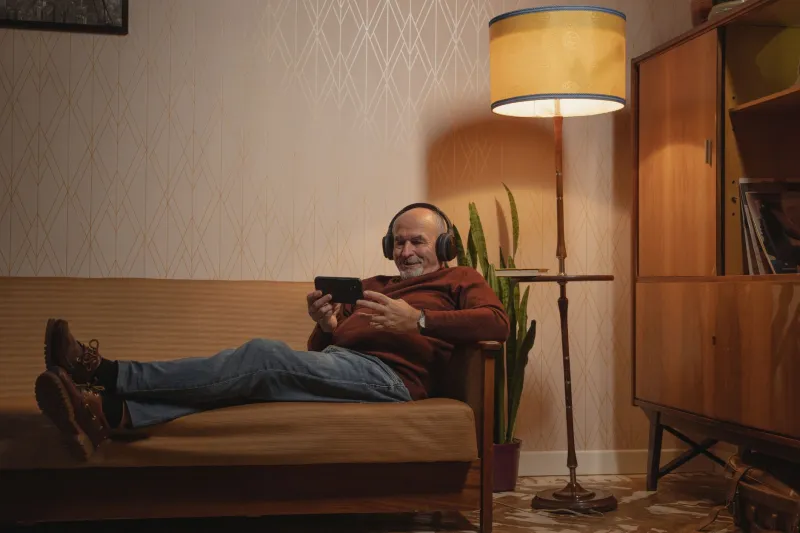
Always One Episode Behind: The Strange Psychology of Watching Anime on Your Phone

You just finished an episode of Frieren: Beyond Journey's End. The closing scene was gorgeous — soft watercolor backgrounds, a quiet musical swell, Frieren standing alone against a horizon that probably looked stunning on somebody's 65-inch OLED. You watched it on your phone while waiting for your burrito order at Chipotle. And now you feel… weirdly hollow about it.
So you hit play on the next episode.
This is the anime phone paradox in a nutshell: the smaller the screen, the bigger the craving for more. And it's not just a quirk of your personality. There's actual psychology behind why mobile viewing leaves fans feeling perpetually one episode short of satisfaction.
Your Brain Knows Something Is Missing (Even When You Don't)
Here's the thing about immersion — your brain doesn't just passively absorb what's on screen. It actively constructs an experience using every sensory input available. Sound depth. Visual scale. Environmental context. When you're watching anime on a six-inch phone screen with one earbud in while the AC hums in the background, your brain is doing a lot of heavy lifting to fill in the gaps.
Cognitive psychologists call this "presence" — the feeling of actually being inside a narrative space. Big screens and quality audio engineer presence almost automatically. Mobile viewing? It forces your brain to manufacture it. And manufactured presence is exhausting. It's also leaky. Your attention drifts, you miss a subtle expression, a background detail, a tonal shift in the score — and your brain registers the loss even if your conscious mind doesn't flag it.
The result is a viewing experience that feels technically complete but emotionally unfinished. You watched the episode. You just didn't feel it.
Pacing Feels Different When You're Holding the Screen
Anime directors spend enormous amounts of time thinking about how silence and stillness function in their work. Hidetaka Tenjin, known for his work in the Macross franchise, has spoken about how the deliberate pauses in anime are designed to let viewers sit inside a moment — to breathe with the characters. Makoto Shinkai's films are famously built around lingering shots that demand your full emotional attention.
On a phone screen, those pauses feel like dead air. Without the physical immersion of a larger viewing environment, silence reads as buffering, not breathing. Slow pans that would feel meditative on a TV feel interminable on a five-inch display. So mobile viewers do what feels natural: they tap forward. They skip. They turn a carefully constructed emotional beat into background noise.
This is why so many phone watchers end up feeling like they "get" a show intellectually but never connect with it emotionally. The architecture of the storytelling was built for an experience that a phone screen quietly dismantles.
The Notification Loop and the Incomplete Feeling
Mobile viewing also introduces something that couch viewing doesn't: the constant low-grade intrusion of everything else on your phone. A text from a friend. A Twitter notification. A random app badge demanding your attention. Each micro-interruption is a tiny fracture in whatever presence you managed to build.
Neuroscience research on attention suggests that even brief interruptions — ones you consciously dismiss in seconds — can disrupt emotional engagement for far longer than the interruption itself. You might refocus on the screen in three seconds, but the emotional thread you were following? That takes considerably longer to reestablish. And in a medium as emotionally precise as anime, those threads matter.
The compounding effect of dozens of these micro-breaks across a single episode leaves viewers with a sense of incompleteness that they can't quite articulate. They know what happened in the episode. They just don't know how it made them feel. So they watch another one, chasing the emotional payoff that keeps slipping away.
Why You Keep Watching Instead of Stopping
This is where the paradox really digs in. In traditional viewing environments, emotional satisfaction acts as a natural stopping point. You feel the weight of a great episode, and your brain signals: that was enough for now. Rest. Digest. Come back tomorrow.
Mobile viewing disrupts that feedback loop. Because the emotional payoff never fully lands, the "that was enough" signal never fires. You're not binge-watching because you're obsessed — you're binge-watching because you're still waiting to actually feel the show. One more episode. Maybe this one will stick.
It often doesn't. And the cycle continues.
Getting Your Viewing Presence Back (Without Ditching Your Phone)
Look, nobody's saying you need to set up a home theater to enjoy anime. Mobile viewing is one of the best things to happen to fandom in the last decade — it's accessible, flexible, and means you can squeeze in an episode during a lunch break or a long commute. But there are ways to reclaim some of that presence even on a small screen.
Use both earbuds. Seriously. Stereo audio is not a luxury here — it's the minimum viable setup for actually experiencing an anime's sound design. One earbud is background noise. Two earbuds are a different experience entirely.
Set a context, not just a time. Watching anime on your phone while doing three other things is not watching anime. Designate your mobile viewing as an activity, not a multitask. Even five minutes of intentional watching beats twenty minutes of distracted half-attention.
Go full screen and go dark. Minimize your notification surface before you hit play. Airplane mode if you can swing it. Dark room when possible. The more you reduce competing sensory input, the more presence you can build on a small screen.
Pair your phone to a speaker. Bluetooth speakers are cheap and they completely transform the audio experience. You don't need anything fancy — just something that fills the room instead of firing directly at your face from six inches away.
Give slow scenes permission to be slow. Resist the urge to tap forward through quiet moments. Those pauses are load-bearing walls in the emotional architecture of the episode. Let them do their job.
The Show Isn't Broken — The Setup Is
If you've ever finished a critically acclaimed series and thought, I don't understand why everyone loves this, there's a real chance the problem wasn't the anime. It was the conditions you watched it in. Mobile viewing is a genuinely different experience from the one most anime creators are building toward — and acknowledging that gap is the first step toward actually closing it.
You don't have to watch everything on a big screen. But you do have to watch with intention. Because the shows you're calling "overrated" might just be waiting for you to actually show up for them.